
Franklin County Sex Offender Checks
The Florida Sexual Offenders and Predators Search is the official starting point for a Franklin County registry check. The Florida Department of Law Enforcement, or FDLE, runs the free statewide system. Information reaches it through county sheriffs, the Florida Department of Corrections, motor vehicle records, and other channels set by law. A county search can show people whose reported residence is in Franklin County, while a name search can find a person whose location is not yet known.
Use the registry for community awareness and personal or family safety planning. It does not declare that a listed person is presently dangerous, and it does not show a complete criminal history. A profile reflects statutory registration data, which differs from a clerk's conviction file or an arresting agency's report. For those source records, contact the clerk in the county of conviction or the agency that made the arrest. Franklin County residents can also contact FCSO about local registration concerns.
Filter Franklin County Registry Results
Start broad when the exact spelling is uncertain. FDLE supports full or partial names, and it permits a search with the names blank when Franklin is selected from the County menu. City and ZIP fields can narrow the list around Apalachicola, Carrabelle, or another local mailing area, but a county filter is often more reliable where postal boundaries and county lines do not align.
The official FDLE offender search interface shows the controls used to build the query.
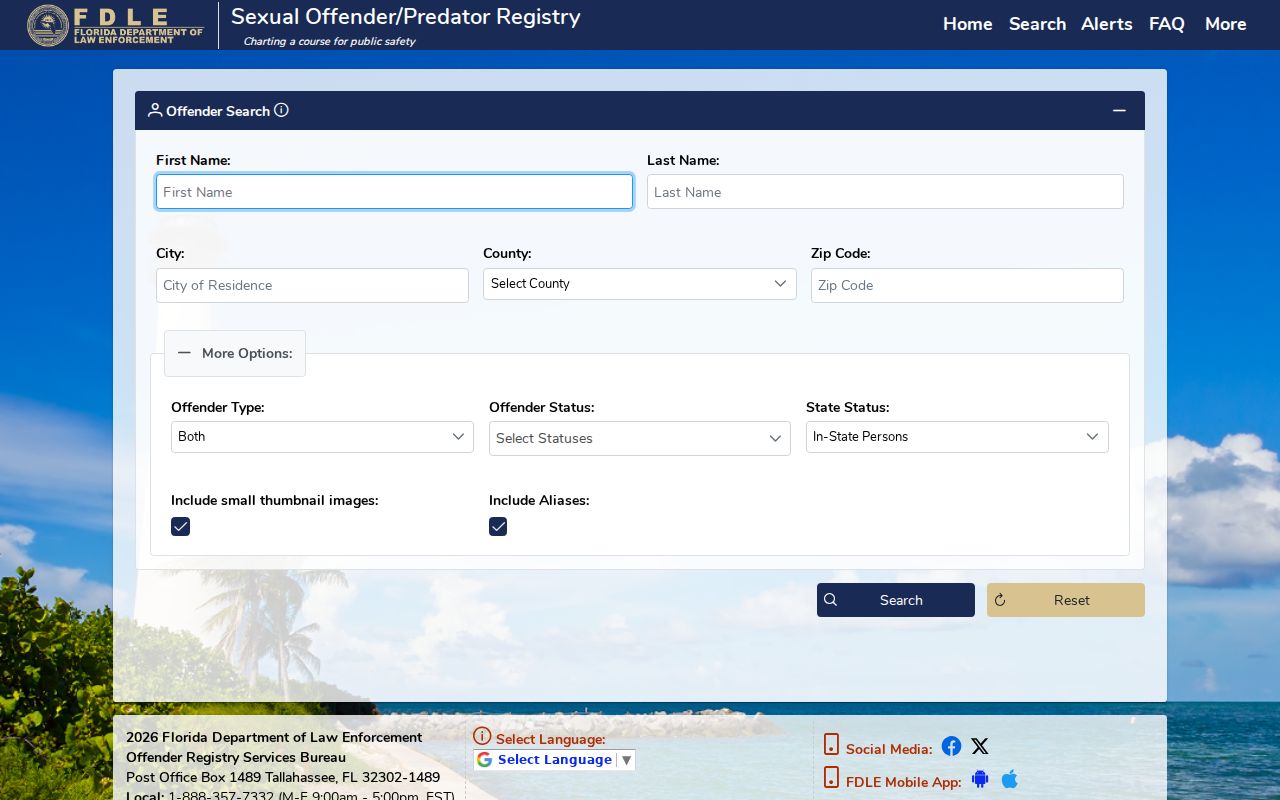
The image helps identify the official search screen before any name, location, or status filter is entered. Small changes can alter the result set, so try both a partial name and the Franklin County filter if the first search misses an expected listing.
Florida Sexual Offenders and Predators Search Searches
FDLE requires at least one basic field: first name, last name, city, county, or ZIP code. Optional filters can limit results by designation or status. Follow a repeatable search path so the final profile, rather than the list thumbnail alone, drives the review.
- Open the official FDLE registry and read its public-use and accuracy notice.
- Enter a full or partial name, or leave names blank and select Franklin County.
- Apply only status or offender-type filters that match the question being researched.
- Open the complete flyer and compare the designation, address source, status, and identifying details.
| Field label | Type | Required | Notes |
|---|---|---|---|
| First or Last Name | Text | One basic field | Full or partial spelling is accepted |
| City, County, or ZIP | Text or dropdown | One basic field | Select Franklin for a county list |
| Offender Type | Dropdown | No | Both, offender, or predator where offered |
| Offender Status | Multi-select | No | Includes released, supervised, confined, absconded, and other states |
| Images and Aliases | Checkbox | No | Expands the result display |
Note: A narrow filter can hide a valid Franklin County result, so clear optional choices before treating a blank list as conclusive.
Franklin County Registry Flyers and Tracking
Search results offer more than a name list. FDLE can display a thumbnail, reported address, designation, current status, and address-source information. The View Flyer control opens a fuller public profile. Track Offender supports notice functions tied to a selected record. Selected entries can also be returned in a printer-friendly format, though PDF output is limited to 25 records at a time.
The FDLE registry FAQ explains the flyer and registration framework behind those controls.
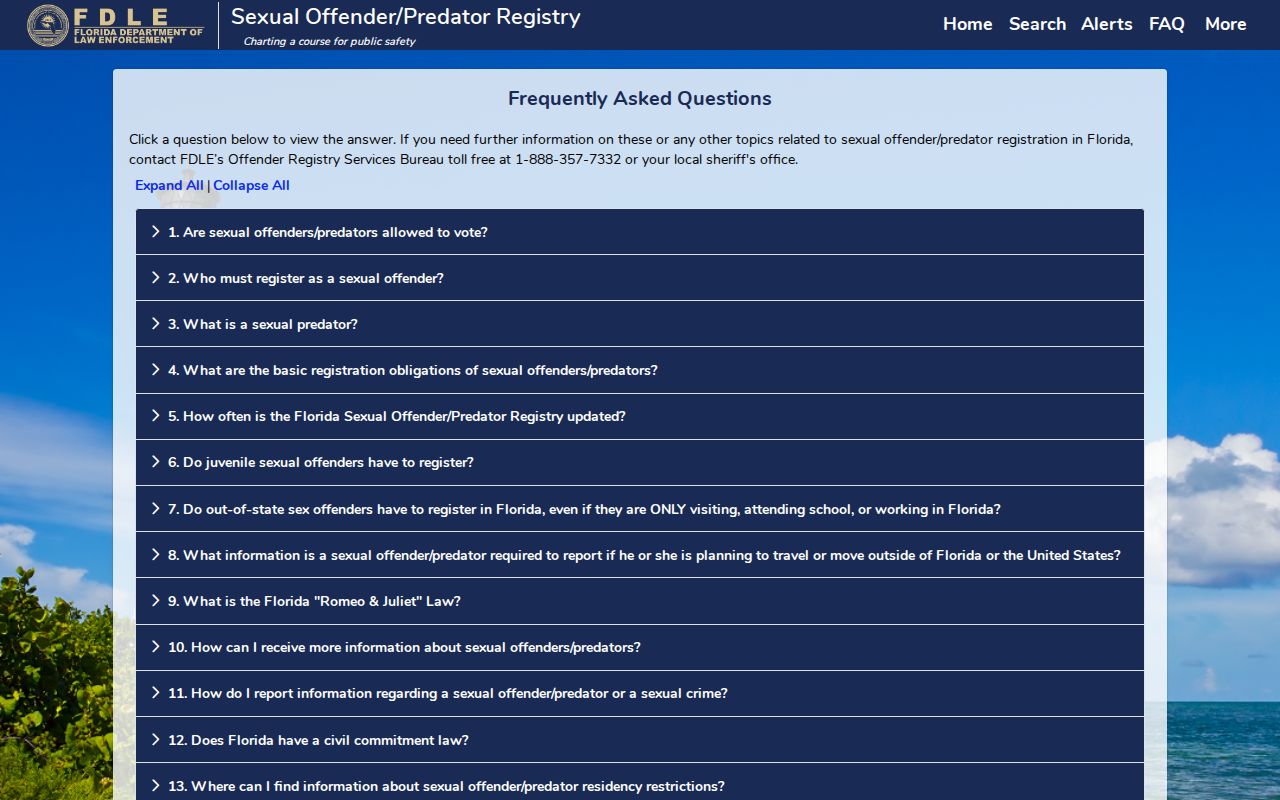
This source is useful when a searcher needs to interpret a field rather than merely retrieve a result. For larger public-data work, FDLE also makes county and statewide CSV files available, which avoids treating the 25-record PDF limit as a cap on county information.
Registry Profiles: What They Show
A public profile combines identification, classification, offense, and location information. Not every field appears for every Franklin County registrant. The public display can vary with the person's legal category, supervision, and record history. Read the field labels closely and avoid filling gaps with assumptions.
| Name and Aliases | Legal name plus reported alternate names and identifying variations. |
|---|---|
| Photo and Description | Photograph, age or birth data, race, sex, height, weight, hair, eyes, and marks where public. |
| Registered Address | Permanent or temporary residence information with source or verification context. |
| Offense Information | Qualifying conviction, offense description, date, place, and statutory basis where displayed. |
| Designation | Sexual offender or sexual predator status under Florida law, not a personal risk score. |
| Registration Status | Released, supervised, confined, absconded, noncompliant, or another published state. |
Vehicles, tattoos, school or institution information, internet identifiers, or supervision source may also appear when law permits. The listing does not mean every past Franklin County arrest or nonqualifying offense is included.
Read Franklin County Registry Addresses
A map marker is a visual aid, not proof about a property or everyone living there. Residence and supervision data can change faster than an online display. Before relying on a Franklin County pin, open the flyer and compare its status, address type, and source or verification date. Do not associate neighbors, schools, businesses, or unrelated household members with the registrant merely because they are near the plotted point.
If an address appears wrong, record the facts without confronting anyone. Send the concern to the Franklin County Sheriff's Office or FDLE Offender Registry Services. City police can receive an urgent public-safety report, but FCSO and FDLE remain the authoritative registration channels. A wrong-looking point should prompt verification, not online republication.
Registration Levels and Duties in Florida
Florida does not use a simple public Tier I, Tier II, and Tier III system. It uses statutory categories. A sexual offender meets qualifying provisions such as section 943.0435. A sexual predator designation follows separate criteria in section 775.21 and, in specified cases, a court process. Frequency and duration depend on the classification, offense, release, supervision, and changes in the law.
| Public category | Duration or basis | Public meaning |
|---|---|---|
| Sexual offender | Often lifetime, subject to the governing facts and narrow relief | Qualifying statutory status, not a risk score |
| Sexual predator | Criteria and designation under section 775.21 | Enhanced designation and notification |
| Juvenile-related registrant | Specific juvenile and federal provisions | Display and confidentiality rules may differ |
| Absconded or noncompliant | Current registry status | Report facts to law enforcement; do not confront |
Some people who meet strict conditions may petition after at least 25 years free from sanctions, confinement, or supervision and without a later felony or misdemeanor arrest. Exclusions apply. The passage of 25 years does not remove a Franklin County entry automatically.
Franklin County Registry Search Layers
FDLE is the primary source for Florida registration details. The National Sex Offender Public Website, operated by the U.S. Department of Justice, adds a cross-state search when a person may have lived beyond Florida or when a Franklin County result needs national context.
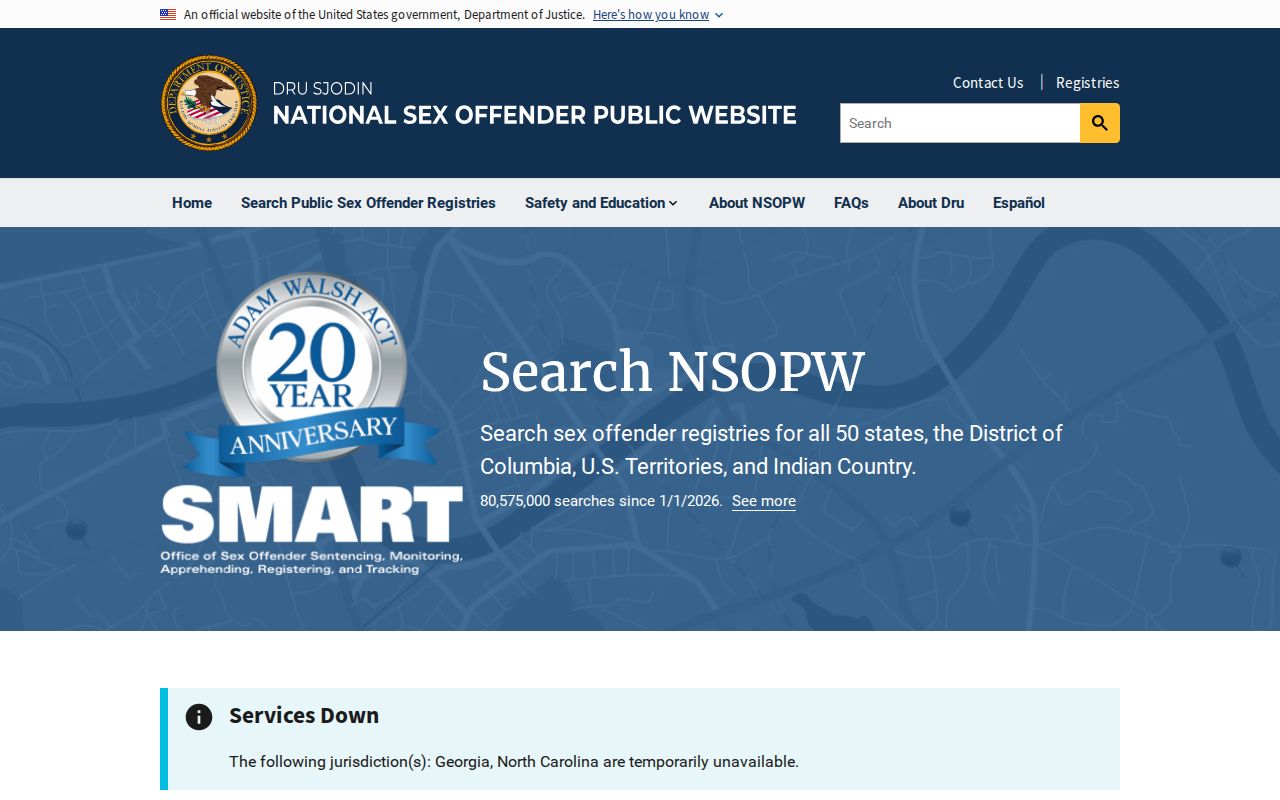
The national screen supplements, but does not replace, the FDLE profile or FCSO report. State systems differ in coverage and update paths. Return to the originating jurisdiction for details that a national result does not display.
FDLE also publishes a prominent notice about the registry's scope and proper use.
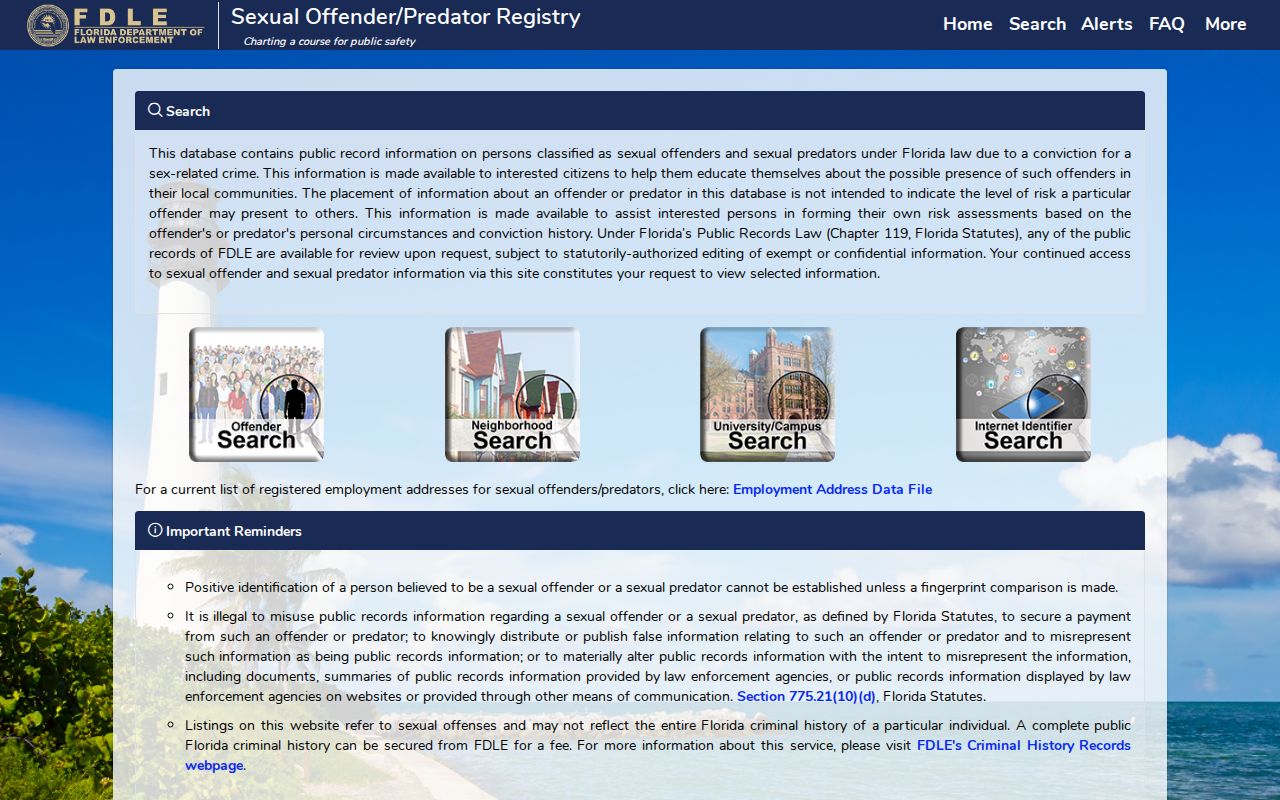
That notice is a reminder to verify current facts and to use the data for lawful awareness, not punishment or rumor.
Correct Franklin County Registry Errors
For a suspected bad address or registration violation, contact the Franklin County Sheriff's Office at 270 State Road 65, Eastpoint, Florida 32328, or call 850-670-8500. Describe the observed issue and the exact registry entry. FDLE Offender Registry Services Bureau also accepts questions at 1-888-357-7332 and sexpred@fdle.state.fl.us. Its mailing address is P.O. Box 1489, Tallahassee, Florida 32302-1489.
FCSO Registration Contact
270 State Road 65
Eastpoint, FL 32328
850-670-8500
FDLE Registry Services
P.O. Box 1489
Tallahassee, FL 32302-1489
1-888-357-7332
Published weekday hours vary between FDLE pages, so calling from 9:00 a.m. to 5:00 p.m. Eastern uses the narrower shared window. Provide facts, not accusations. For the underlying conviction, request the court file from the clerk that entered it.
Using Registry Information Lawfully
Registry data supports personal, family, and neighborhood safety choices. It does not license threats, harassment, vigilantism, false public claims, or pressure for payment. Florida law also bars knowingly publishing false registry material as a public record and materially altering public information with an intent to misrepresent it.
Misuse warning: Harassing, threatening, falsifying, or materially altering registry information can violate Florida law. Report suspected noncompliance to FCSO or FDLE and do not confront a listed person.
Relevant authorities include the Chapter 943 registration and database provisions and the Florida Sexual Predators Act. The safest practice is simple: read the full official profile, confirm dates and status, and send a concern to the agency that can investigate it.
Community notice also requires care with timing. A released status, a supervision label, and an address-source date answer different questions. None should be turned into a claim about conduct that the registry does not report. Save the official flyer when a current record must be documented, note when it was viewed, and return to FDLE for a later update. When safety appears urgent, call law enforcement and describe the conduct or condition observed rather than trying to enforce registration duties personally.
Underlying court records remain the best source for the qualifying conviction. A Franklin County registry result may point to a conviction from another Florida county or another state, so the originating clerk may hold the judgment. The public registry remains the right source for present Florida registration status. Keeping those two roles separate prevents an old court document from being mistaken for a current address report.