
Carrabelle Criminal History Checks
Begin a Carrabelle criminal record check by deciding whether the goal is a police narrative, booking entry, filed case, or statewide identity record. The Carrabelle Police Department is the official starting point for reports made by city officers. It does not publish a stable report form, fee list, arrest blotter, criminal portal, or official app. Confirm the current request channel before sending details.
The Carrabelle Annex offers a nearby clerk counter, but Circuit and County Court cases remain Franklin County matters. Current custody usually routes to the Sheriff in Eastpoint. Florida-wide reported history comes from FDLE. Work outward only as far as the record calls for.
- Use the official Carrabelle Police site to verify the current records contact and request method.
- Describe the city report with its number or the event date, time, place, and exact item sought.
- Call the Franklin Clerk Carrabelle Annex with a case or citation number and confirm that the needed service is available.
- Contact the Franklin County Sheriff's Office for Eastpoint jail booking or current county custody information.
- Use FDLE when Florida-wide history or a fingerprint review of your own record is needed.
Carrabelle Police Request Details
A useful Carrabelle police-record request identifies the exact item instead of asking for all records about a person. Include the CPD report number when known. Otherwise, provide the event date, approximate time, location, and the involved or reporting person's name. Say whether the request seeks an incident report, arrest affidavit, dispatch record, or a defined audio or video segment. Add a delivery route and preferred format.
No official Carrabelle base copy fee or records-unit hours were found. Ask for a cost estimate and the legal basis for any redaction. A broad video request can take more staff time than a short report.
| Request field | Why it helps | Local note |
|---|---|---|
| CPD report number | Points to one city event | Use it when available |
| Date, time, and place | Narrows a report search | Useful when the number is unknown |
| Exact record | Defines the material | Name report, CAD, audio, or video |
| Format and delivery | Helps estimate production | Ask about electronic delivery |
Records at Carrabelle Police
Carrabelle Police is the city custodian for incident narratives and arrest paperwork created by its officers. A city report starts with CPD, not City Hall, the clerk, or the county jail. If another agency investigated the event, send the request to that agency instead.
A Carrabelle police report may identify alleged conduct, responding officers, property or evidence, involved parties, and an arrest basis. It does not establish guilt. It also does not replace the later charging paper, docket, judgment, or sentence held by the Franklin Clerk.
The famous “world's smallest police station” is Carrabelle history. It is not a safe substitute for a verified current records-counter address. Check the department's official site immediately before a visit or mailed request.
Carrabelle's County Record Route
The Franklin County government directory shows why a Carrabelle event can produce records beyond city limits. The county Clerk maintains court files, while the Sheriff and jail handle county custody records. The official county page captured below is the successful Carrabelle image assigned in the manifest.
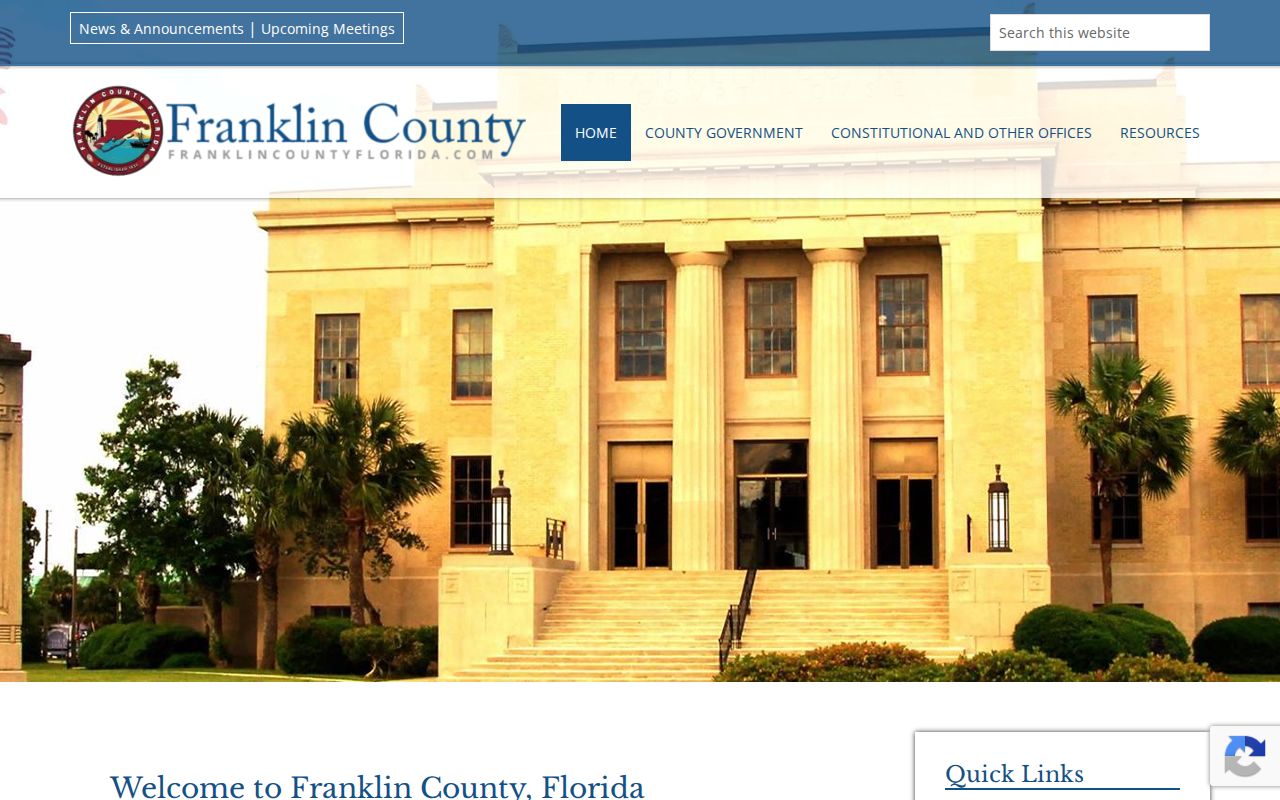
That county layer matters after a Carrabelle arrest. City police may hold the first report, but booking and court records usually sit with Franklin County offices in Eastpoint and Apalachicola.
Booking and Arrest Records in Carrabelle
Carrabelle Police may create an arrest report, yet a person arrested in the city is generally booked through the Franklin County Jail at 270 State Road 65 in Eastpoint. The city does not publish a verified arrest blotter. The Sheriff also did not expose a stable public booking-log URL during research. Use official phone and public-record channels instead of an unofficial roster.
For current custody, call the Franklin County Sheriff's Office at 850-670-8500. For booking material held by FCSO, contact Public Records at 850-670-4807 or use its Chapter 119 instructions. Give a name, booking date or number, city report number, and the precise fields sought. If prosecution has begun, the charge filed by the State Attorney may differ from the police holding charge.
A Carrabelle arrest is not proof of conviction. Read the clerk docket for the filed count and final outcome. The broader county process is covered in the Franklin County arrest search.
Carrabelle Prison Records Are State Records
Franklin Correctional Institution is associated with Carrabelle, but it is a Florida Department of Corrections state-prison facility. It is not the Carrabelle Police lockup. It is also not the Franklin County Jail. Mixing these systems sends a record request to the wrong custodian.
Use FDC Offender Search after a state-prison transfer or when looking for state incarceration and supervision information. Search by a last and first name or by DC number, then use demographic filters to narrow a match. For a recent Carrabelle arrest, begin with CPD and FCSO. For the criminal prosecution, use the Franklin Clerk.
Quick distinction: Carrabelle Police creates the city report; FCSO books county detainees in Eastpoint; FDC maintains state-prison records.
The Carrabelle Municipal Court File
Carrabelle does not maintain a separate felony court or an independent city criminal docket. Felony cases go to Circuit Court, and misdemeanors go to Franklin County Court. A city citation or ordinance matter can start with Carrabelle enforcement, but the Franklin Clerk is the safe published route for the case record. Search Court Records, not the separate Official Records system used for recorded documents.
| Court system | Franklin County Court for misdemeanors and criminal traffic; Circuit Court for felonies |
|---|---|
| City matters | Ordinance or citation matters may begin with Carrabelle enforcement |
| Lookup channel | Franklin Clerk Search Court Records gateway or a clerk counter |
| Docket contents | Case number, filing date, status, charges, events, hearings, disposition, and available images |
| Copies and fees | Ask the Clerk for current copy and certification terms; no Carrabelle-specific fee was published |
Carrabelle Annex Record Access
The Franklin Clerk's Carrabelle Annex at 912 N.W. Avenue A gives eastern Franklin County residents a local clerk contact. Call 850-697-3263 before traveling. The published information does not promise that every criminal service or archived file is available at this counter.
Bring the complete case or citation number if known. A party name, approximate filing date, and the kind of copy needed can help staff route the inquiry. The annex is not a second Carrabelle court system. When a file or certified disposition must come from the principal office, the Franklin County Courthouse and Clerk are at 33 Market Street, Suite 203, Apalachicola.
Franklin Clerk Carrabelle Annex
912 N.W. Avenue A
Carrabelle, FL 32322
850-697-3263
Call first for criminal service and archive availability.
How Carrabelle Records Reach the County
A Carrabelle officer creates the first city report. If an arrest occurs, the Eastpoint jail makes the booking record and sends fingerprints and arrest data through Florida's criminal-justice network. The State Attorney may decline, change, or file charges. Once filed, the Franklin Clerk maintains the Circuit or County Court case. The later disposition is reported to FDLE for the statewide criminal-history record.
Record flow: Carrabelle Police › Franklin County Jail › Franklin County Courts › Florida Department of Law Enforcement
Timing changes what is visible. CPD may hold an incident report before a prosecution exists. A jail entry can show a holding charge that later changes. The clerk docket is best for the filed count and outcome. FDLE is broader, but a name match can be incomplete or tied to the wrong person. For review of your own identity-based Florida file, FDLE uses fingerprints.
Carrabelle in the Second Circuit
Carrabelle cases are part of Florida's Second Judicial Circuit, which also serves Gadsden, Jefferson, Leon, Liberty, and Wakulla counties. That circuit structure explains why a prosecutor, defender, court program, or administrative office may be based outside Carrabelle while still handling a Franklin County case.
The location of a regional office does not move the public docket. The Franklin Clerk remains the records custodian for a local court file. The State Attorney screens referrals and files informations. The Public Defender represents eligible appointed defendants, but its file is not the public court record. Ask the clerk for pleadings, orders, judgments, and certified dispositions.
Carrabelle residents may see a Tallahassee address on material from a circuit-wide office. That does not move the prosecution out of Franklin County. The State Attorney screens and files charges across the circuit, and the Public Defender serves eligible appointed defendants through the same regional structure. For a public judgment, sentence, or certified disposition, the Franklin Clerk remains the record custodian. For advice or representation, use the attorney named in the case rather than asking the records counter to interpret the docket.
Always call first before a regional office visit because published Franklin schedules can change.
Carrabelle Reports and Case Files Differ
A Carrabelle Police report and a Franklin Clerk case file answer different questions. The police report describes what the officer observed, received, or alleged at the start. It can include a narrative, event location, initial offense label, property details, and arrest paperwork. The clerk file begins when a court matter is created and records the charge the State Attorney actually filed.
The distinction matters when facts seem to conflict. A prosecutor can amend or decline the officer's proposed count. A judge can dismiss a charge, withhold adjudication, accept a plea, or enter a sentence. None of those later events rewrites the original city report. Read both sources when reviewing your own Carrabelle matter, and treat the final court disposition as the source for how the filed case ended.
- Police report
- The Carrabelle agency narrative and related event material.
- Booking record
- The Eastpoint jail intake and custody entry, not a conviction.
- Case file
- The Franklin Clerk docket, pleadings, orders, judgment, and sentence.
- FDLE history
- Florida arrest cycles and reported dispositions linked through state systems.
Carrabelle Record Access Rules
Florida Public Records Law applies to nonexempt records held by Carrabelle Police and other local custodians. Request the item from the office that created or maintains it. A public agency may redact protected victim data, personal identifiers, juvenile information, sealed or expunged material, and details covered by an active-investigation exemption. Ask for the public remainder when only part of a file is protected.
Chapter 119 permits lawful copy charges and a special service charge when a request requires extensive clerical, supervisory, or technology work. Narrow dates and identify the exact Carrabelle record to reduce search time. Court confidentiality is governed separately by Florida court rules. Public access to a docket does not mean every image is available online.
Key Statutes:
Florida Statutes Chapter 119 sets inspection, copy, redaction, response, and lawful charge rules for agency records.
Florida Statutes Chapter 943 governs FDLE criminal-history dissemination, along with sealing and expungement provisions.
Florida court-record access rules identify confidential court content and the process for access.