
Apalachicola Criminal History Checks
Apalachicola criminal records are divided among the city police department, Franklin County Clerk, Franklin County Sheriff's Office, and FDLE. Begin with the type of record, not a broad request for everything. The city report explains the officer's response. The booking record documents intake at the county jail. The clerk file shows charges filed by the State Attorney and the court's outcome. FDLE adds reported Florida arrest and disposition cycles.
- Use the official Apalachicola city directory to locate the current Police Department contact for a city incident or arrest report.
- Give the APD case number, date, time, location, parties, and exact report, video, audio, or dispatch item sought.
- Search the Franklin Clerk's Court Records gateway for a filed case, then request a certified disposition when needed.
- Call FCSO for current custody or request a booking record under Chapter 119 when the person was taken to the Eastpoint jail.
- Use FDLE for wider Florida history or fingerprint-based review of your own state record.
Each step answers a different question. A blank clerk search does not prove that no city police contact occurred. Likewise, an arrest narrative does not establish that prosecutors filed the same charge or that a court found guilt.
Apalachicola's Three-Stop Record Route
The central Apalachicola records fact is geographic as well as legal. A city officer may create the report in Apalachicola. The county jail books people at 270 State Road 65 in Eastpoint, across Apalachicola Bay. The court file is maintained by the Franklin County Clerk at the courthouse in downtown Apalachicola. Thus, “arrested in Apalachicola” and “booked in Eastpoint” may both describe the same event.
| Record sought | Starting office | Best identifier |
|---|---|---|
| City incident or arrest narrative | Apalachicola Police | APD case number or date, time, and location |
| Booking or present county custody | Franklin County Sheriff | Name, booking date, or booking/case number |
| Filed charge, judgment, or certified disposition | Franklin County Clerk | Case number, party name, or citation number |
| Reported statewide history | FDLE | Name and reliable demographic details |
This routing saves time in a dispersed 545-square-mile county. It also keeps a request from landing with an office that never created the requested record.
Records at Apalachicola Police
Apalachicola Police is the first custodian for a city officer's incident narrative, arrest paperwork, and related city-held media. Start from the Police Department listing on the official City of Apalachicola website because department pages and contact details can change. Research did not verify a stable online report form, searchable arrest blotter, records email, current counter address, hours, base copy fee, or police mobile app.
The city's official homepage is the approved visual source for this Apalachicola records route.
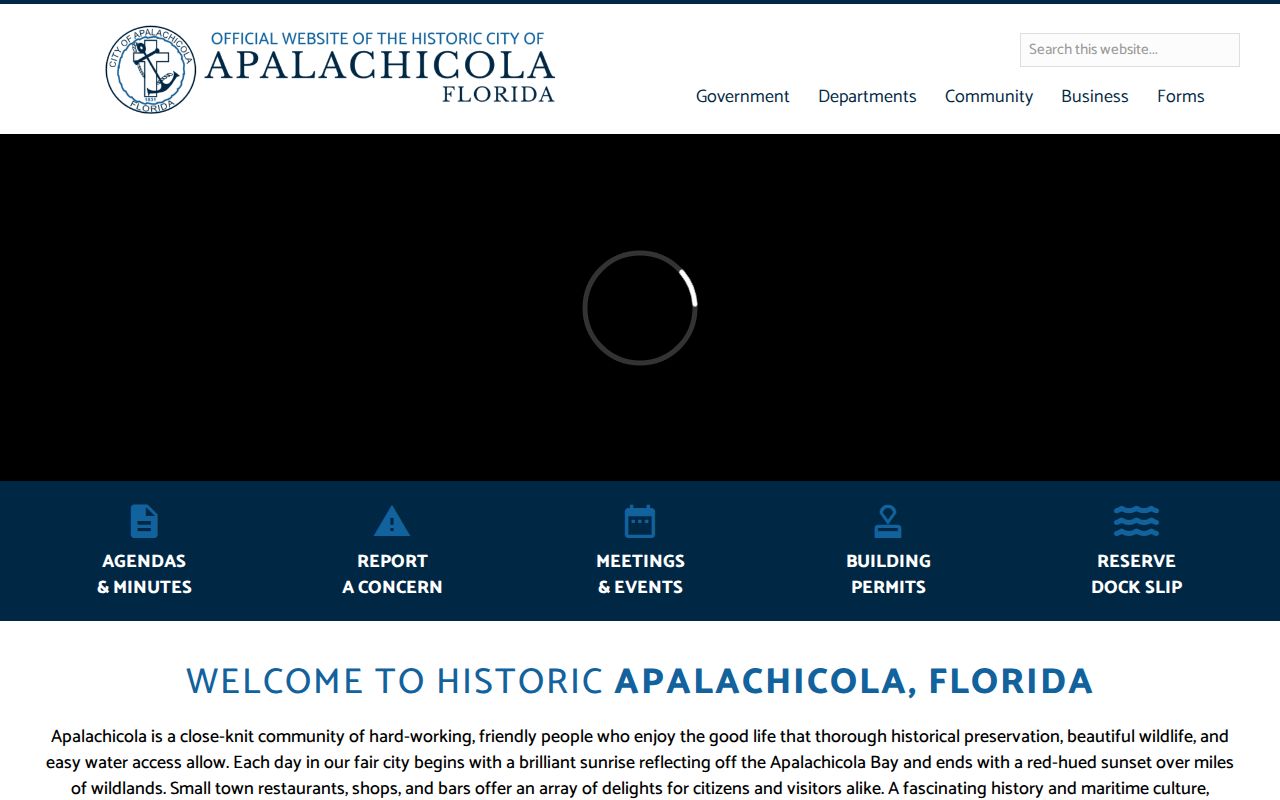
The city source helps a requester find the current department directory without relying on an old third-party listing. Verify the contact before visiting or sending a request. A request should identify the APD case number if known, incident date and time, location, involved or reporting party, precise record sought, preferred format, and a delivery route.
Ask whether identification is needed only when seeking protected victim access. For an ordinary public request, do not volunteer unrelated private data. If audio or video is involved, narrow the time span and ask for an estimate before production.
When Apalachicola Holds the Report
A city police narrative stays with the agency that created it. It is not automatically copied into a county-wide report pool. This point matters when Apalachicola Police, FCSO, or a state agency could have handled an event near the waterfront, U.S. 98, or another jurisdictional edge. Check the report or citation for the agency name before sending a request.
If no case number is available, give the date, approximate time, exact location, and reporting party. Name the item precisely, such as an incident report, arrest affidavit, CAD log, 911 audio, or body-camera segment. Ask for electronic production and the public, separable portion if some material is exempt. The city may redact protected victim data, active investigative detail, juvenile content, or other information protected by Florida law.
Request checklist: Include the APD case number or incident details, exact record, format, delivery route, and willingness to receive a cost estimate. No official city report fee was located.
Booking and Arrest Records in Apalachicola
People arrested by Apalachicola officers are generally booked through the Franklin County Jail in Eastpoint. The booking entry can show jail intake, the holding charge, bond, and custody or release information. It does not decide guilt, and the charge received at intake may later differ from the count filed by the State Attorney.
For present custody, call the Franklin County Sheriff's Office at 850-670-8500. For a booking record held by FCSO, use its public-records process. The office accepts a precise request by email, phone, mail, or in person. Its records contact is Dana Pavon, 850-670-4807, PublicRecords@franklinsheriff.com, at 270 State Road 65, Eastpoint, Florida 32328. Published records hours are 8:30 a.m. to 4:30 p.m. weekdays, excluding holidays.
FCSO does not require a requester to give a name, but it needs a delivery method. Email addresses become public records, so phone, mail, or an in-person request can be used when a requester prefers not to disclose an email address. If a report remains open or a capias has been requested, release may be limited until disposition or closure.
Apalachicola Court Records Downtown
The Franklin County Courthouse stands at 33 Market Street, Suite 203, in Apalachicola's historic downtown. The clerk counter is open from 8:00 a.m. to 4:30 p.m. on weekdays, and the main number is 850-653-8861. This is the right route for a prosecution docket, judgment, sentence, or certified disposition, not for the city officer's full narrative.
Franklin County Clerk
33 Market Street, Suite 203
Apalachicola, FL 32320
850-653-8861
Weekdays, 8:00 a.m.-4:30 p.m.
FCSO Jail and Records
270 State Road 65
Eastpoint, FL 32328
850-670-8500
Records: 850-670-4807
Use the Franklin Clerk records gateway and choose Court Records, not Official Records. Official Records is the land and recorded-document system. If a document image is missing, call the clerk with the case number, filing date, and exact document. Older files may need archive retrieval, and certification can require a separate charge that was not published in the inspected source.
The Apalachicola Municipal Court File
Apalachicola does not operate a separate felony court. Circuit Court hears felonies. Franklin County Court handles misdemeanors, criminal traffic, and county-level matters. A city ordinance or municipal citation can begin with city enforcement, but the Franklin Clerk is the safe published case-record gateway. Do not assume a city citation creates an independent Apalachicola criminal docket.
| Court Name | Franklin Circuit Court for felonies; Franklin County Court for misdemeanors and county-level matters. |
|---|---|
| City Matters | Ordinance or citation matters may originate with Apalachicola enforcement. |
| Case Lookup | Franklin Clerk Court Records gateway, clerk counter, or phone at 850-653-8861. |
| Docket Contents | Case number, filing, charge, events, hearings, disposition, judgment, sentence, and available images. |
| Copies and Fees | Ask the clerk for current copy, archive, and certification charges; official figures were not located. |
If a citation does not appear, call the issuing department and clerk with its number and date. A docket may also lag a recent city event or omit a confidential image even when the case index is public.
Apalachicola Citation or County Case
The label on the first city paper does not always match the final court category. A municipal citation may remain an ordinance matter, while a criminal allegation can move into County Court or Circuit Court according to the filed charge. The State Attorney may decline, amend, or file charges after reviewing the city report. The filed information controls the prosecuted counts, and the final judgment controls the court outcome.
- Incident report
- The city officer's account of the event and response.
- Information
- The formal charge filed by the State Attorney.
- Disposition
- The result of a charge or case, such as dismissal, plea, acquittal, or judgment.
- Certified copy
- A clerk-authenticated court record used when an ordinary printout is not enough.
A dismissed or nolle-prossed case is not a conviction. A withhold of adjudication is not a dismissal. For fuller treatment of filings and dispositions, use the Franklin County court case lookup.
How Apalachicola Records Reach the County
Once an Apalachicola officer makes an arrest, the city keeps its agency report while the jail creates a separate custody record. Fingerprints and arrest data can pass through Florida's criminal-justice network to FDLE. The State Attorney then decides whether and what to file. The clerk records the court events and later disposition.
Record flow: Apalachicola Police › Franklin County Jail and Courts › Florida Department of Law Enforcement
That flow is not instant. A recent city arrest may exist before a clerk case appears. A final disposition may take time to reach FDLE. When reviewing your own Apalachicola record, compare the city or booking report, clerk disposition, and FDLE history. A conflict should be taken to the office that owns the incorrect field.
Note: One blank Apalachicola search does not clear every layer because city, jail, court, and state systems update on different schedules.
Apalachicola Dockets Miss Police Contacts
A clerk docket is a case file, not a catalog of every police call. An Apalachicola incident may never produce an arrest. An arrest may not lead to a filed prosecution. Alternate spellings can split results, and a recent filing may take time to appear. Sealed, expunged, juvenile, victim, and other protected material can also be absent or redacted.
When a known city event is missing, check the agency first and then call the clerk with a date range and identifiers. For a Florida-wide view, FDLE offers a public name search for $24 plus a $1 Instant Search card-processing fee. That state result is broader than Apalachicola, but it has less documentary detail than the court file. A fingerprint-based FDLE Personal Review is the stronger route for checking and correcting your own identity-linked Florida history.
Apalachicola Record Access Rules
Florida's access framework begins with the presumption that nonexempt public records can be inspected or copied. The practical rule is to ask the custodian that made or maintains the record. Apalachicola Police handles its city reports, FCSO handles its bookings and sheriff records, the clerk handles court cases, and FDLE handles statewide history.
Key statutes:
Florida Constitution, article I, section 24 establishes public access subject to exemptions.
Florida Public Records Law, Chapter 119 governs inspection, copying, reasonable response time, fees, and redaction.
Florida Statutes, Chapter 943 governs FDLE criminal-history dissemination and related restrictions.
An agency may charge lawful duplication or extensive-use costs and may redact exempt content. Ask for the public portion, a written basis for withholding, electronic production when suitable, and an estimate if the request is broad. Confidential juvenile records, sealed or expunged files, protected victim details, Social Security numbers, and bank data do not become public because another part of the file can be released.
Apalachicola City Hall Is Not the Archive
City Hall is a useful directory and government contact point, but it is not the clerk's criminal archive. The distinction is easy to miss because the courthouse is also in Apalachicola's compact historic center. Ask the city for the Police Department route when the city created the report. Ask the county clerk for filed charges, orders, judgments, and certified dispositions.
Apalachicola is one of only two incorporated cities in Franklin County. Its county-seat role puts the courthouse close to the river, bay, seafood, maritime, tourism, and U.S. 98 activity that shapes the downtown. Yet jail custody still sits across the bay in Eastpoint. Phone and email fallbacks matter when the proper record is held at a different stop than the event itself.